Oct 12, 2026
The Critical Role of Precision Shaft Alignment
The Critical Role of Precision Shaft Alignment
Shaft alignment is one of the most important factors in the reliable operation of rotating machinery. Motors, pumps, gearboxes, compressors, conveyors, and other industrial equipment depend on accurately aligned shafts for efficient power transmission and smooth operation.
Even a small alignment error can increase vibration, bearing loads, coupling stress, and energy consumption. Over time, these issues can lead to premature component failure and unexpected machine downtime. This is why precision shaft alignment should be treated as an essential part of equipment installation, commissioning, and maintenance.
What Is Shaft Alignment?
Shaft alignment is the process of positioning two connected shafts so that their rotational axes are correctly aligned within specified tolerances.
In a typical drive system, a motor transfers power to equipment through a coupling. The coupling can accommodate a certain amount of misalignment, but it is not designed to compensate for unlimited installation errors.
Proper alignment helps the connected equipment operate as a coordinated system rather than forcing the coupling, bearings, and shafts to compensate for positioning errors.
Why Precision Alignment Matters
Correct shaft alignment provides several important benefits for industrial machinery.
1. Reduces Excessive Vibration
Misaligned shafts can create abnormal vibration during operation. Excessive vibration may affect bearings, couplings, seals, and other rotating components.
Precision alignment helps reduce unnecessary vibration and supports smoother machine operation.
2. Protects Couplings
Couplings are designed to transmit torque while accommodating specific levels of movement or misalignment. When alignment is outside the recommended limits, the coupling may experience additional forces and stresses.
This can result in faster wear, damaged flexible elements, or reduced coupling service life.
3. Extends Bearing Life
Shaft misalignment can place additional radial and axial loads on bearings. These unwanted loads can increase bearing temperature and accelerate wear.
Proper alignment helps distribute loads more effectively and can contribute to longer bearing operating life.
4. Improves Energy Efficiency
Misalignment creates additional resistance within a rotating system. The motor may need to work harder to overcome these mechanical losses.
Although alignment is only one factor affecting energy consumption, maintaining proper shaft positioning can help improve the overall efficiency of the drive system.
Types of Shaft Misalignment
Shaft misalignment generally falls into several categories.
Angular Misalignment
Angular misalignment occurs when the centerlines of two shafts intersect at an angle rather than remaining properly aligned.
This condition can place additional loads on the coupling and connected bearings.
Parallel Misalignment
Parallel, or offset, misalignment occurs when the two shaft centerlines are parallel but positioned at different locations.
This can generate additional radial forces during rotation.
Combined Misalignment
In real-world applications, angular and parallel misalignment can occur simultaneously. Precision alignment procedures therefore need to evaluate both conditions rather than focusing on only one type.
Causes of Shaft Misalignment
Shaft alignment can change even after equipment has been correctly installed.
Common causes include:
Incorrect initial installation
Foundation movement
Thermal expansion
Pipe strain
Bearing wear
Loose mounting bolts
Machine movement
Improper shimming
External vibration
Changes in operating conditions
For this reason, alignment should be considered an ongoing maintenance concern rather than a one-time installation task.
Precision Alignment Methods
Traditional alignment methods may use straightedges, feeler gauges, dial indicators, or other mechanical measurement techniques. These methods can be useful when applied correctly.
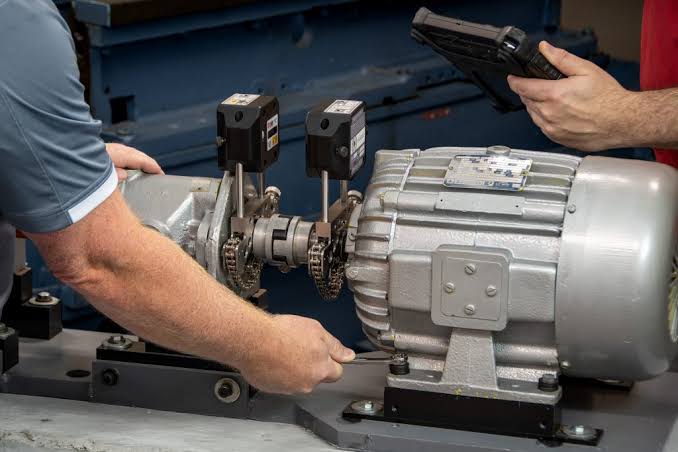
Modern industrial maintenance increasingly uses laser alignment systems. Laser-based tools can provide accurate measurements of shaft position and help technicians determine the required corrections.
The appropriate alignment method depends on the machine configuration, required accuracy, accessibility, and operating conditions.
The Importance of Proper Shimming
Shimming is commonly used to adjust the vertical position of machinery during alignment.
Poor-quality, damaged, excessive, or incorrectly installed shims can create an unstable machine position. This can cause alignment to change after the equipment is returned to service.
Proper shim selection and installation are therefore important parts of precision alignment.
Soft Foot and Shaft Alignment
Soft foot is another condition that should be checked during the alignment process.
A machine may appear aligned while one or more mounting feet are not sitting correctly on the foundation. Tightening the mounting bolts can then distort the machine frame and change shaft alignment.
Identifying and correcting soft foot before final alignment can help produce more stable results.
Thermal Growth Must Be Considered
Machines operating at elevated temperatures may experience thermal expansion. As equipment heats up, the relative position of shafts can change.
For systems with significant temperature differences between operating and ambient conditions, alignment calculations may need to account for expected thermal growth.
Ignoring thermal effects can result in an apparently correct cold alignment becoming an incorrect alignment during normal operation.
How Proper Alignment Supports Coupling Performance
A coupling is an important part of a rotating drive system, but even a flexible coupling has operating limits.
When shafts are correctly aligned:
Coupling stresses can be reduced.
Flexible elements can operate within their intended range.
Bearing loads may be reduced.
Vibration can be minimized.
Power transmission can become more reliable.
Component life can potentially be extended.
Therefore, coupling selection and shaft alignment should be considered together when designing or maintaining a power transmission system.
Best Practices for Precision Shaft Alignment
For reliable results, maintenance teams should follow a systematic alignment procedure:
Inspect the foundation and mounting arrangement.
Check for soft foot.
Inspect the coupling and shaft condition.
Measure the initial alignment condition.
Correct vertical and horizontal alignment.
Account for thermal growth where required.
Tighten mounting bolts correctly.
Recheck the alignment after tightening.
Verify the final alignment against the equipment specifications.
Record alignment measurements for future maintenance.
Final Thoughts
Precision shaft alignment is more than a routine installation procedure. It is an important part of maintaining the reliability, efficiency, and service life of rotating machinery.
Proper alignment can help reduce vibration, protect couplings and bearings, improve power transmission, and minimize the risk of unexpected equipment failures. For demanding industrial applications, accurate measurement and professional alignment practices can make a significant difference in long-term machine performance.
By combining the right coupling with accurate shaft alignment and proper maintenance, industrial operators can build a more reliable and efficient power transmission system.