Oct 12, 2026
Rubber Damping vs All-Metallic Grid Couplings
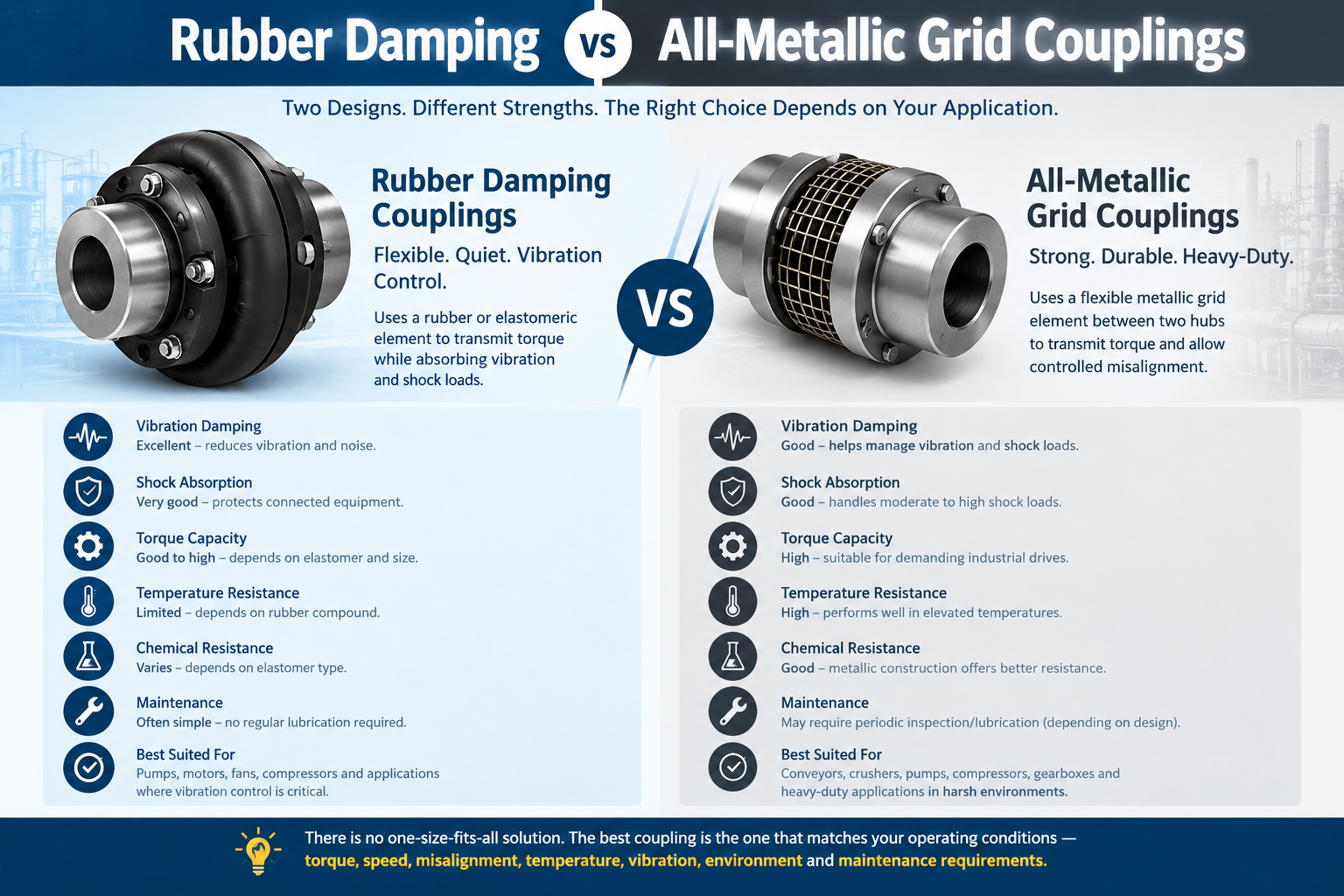
Rubber Damping vs All-Metallic Grid Couplings: Which Is Right for Your Application?
Couplings play an important role in industrial power transmission systems by connecting shafts and transferring torque between rotating equipment. Beyond simply transmitting power, the right coupling can help manage vibration, shock loads, and shaft misalignment.
Two common approaches are rubber or elastomeric damping and all-metallic grid coupling designs. Both can be effective, but they provide different operating characteristics and are suited to different machine requirements.
Understanding the differences between these coupling technologies can help engineers and maintenance teams select the appropriate solution for their application.
What Is Rubber Damping?
Rubber or elastomeric couplings use a flexible rubber element to transmit torque between two shafts. The elastomer acts as a flexible connection between the driving and driven equipment.
One of the major advantages of this design is its ability to absorb and damp mechanical vibration and shock loads.
The flexible rubber element can help isolate connected equipment from sudden torque fluctuations, making this type of coupling useful in applications where vibration control is an important consideration.
What Are All-Metallic Grid Couplings?
All-metallic grid couplings use a flexible metallic grid element positioned between two hubs. The grid transmits torque while allowing a controlled amount of shaft misalignment.
Unlike rubber elements, metallic grid elements are designed to operate without relying on an elastomeric material for flexibility.
Grid couplings are commonly considered for industrial applications where reliable torque transmission, shock-load handling, and mechanical durability are important.
Rubber Damping vs Grid Couplings
The most important difference between the two designs is how they handle vibration, shock, and flexibility.
| Feature | Rubber/Elastomeric Coupling | All-Metallic Grid Coupling |
|---|---|---|
| Vibration damping | Excellent | Good |
| Shock absorption | Very good | Good |
| Torque transmission | Good to high | High |
| Temperature resistance | Depends on elastomer | Generally high |
| Chemical resistance | Depends on rubber compound | Generally good |
| Maintenance | Often relatively simple | May require periodic inspection/lubrication depending on design |
| Material flexibility | Elastomeric | Metallic |
| Heavy-duty applications | Application dependent | Well suited to many heavy-duty drives |
Actual performance depends on the specific coupling design, material, size, and operating conditions.
Vibration and Shock Absorption
For applications where vibration isolation is a primary requirement, rubber damping can provide a significant advantage.
The elastomer can absorb a portion of the energy generated by torque fluctuations and mechanical impacts. This can help protect connected equipment and improve operating smoothness.
Grid couplings can also help manage shock loads and vibration, but their primary flexibility comes from the metallic grid element. The performance characteristics therefore differ from those of an elastomeric coupling.
Torque Capacity
Torque requirements are a major consideration when selecting a coupling.
All-metallic grid couplings can provide high torque transmission capacity while maintaining flexibility for certain types of shaft misalignment. This makes them suitable for many demanding industrial drives.
Rubber couplings are also available in designs capable of transmitting substantial torque, but their capacity and performance can be influenced by the properties of the elastomer and operating temperature.
The coupling should always be selected according to the actual torque, speed, service factor, and operating conditions rather than relying only on a general coupling type.
Temperature Considerations
Temperature can have an important effect on coupling performance.
Rubber and elastomeric materials have defined operating temperature ranges. Prolonged exposure to excessive heat can change their mechanical properties and potentially reduce service life.
Metallic grid elements are generally less sensitive to high temperatures than elastomeric materials. For applications involving elevated operating temperatures, this can make an all-metallic solution attractive.
However, the complete coupling assembly—including lubrication, seals, and surrounding components—must still be evaluated for the application's temperature range.
Chemical and Environmental Conditions
The surrounding environment should also influence coupling selection.
Rubber compounds can have different levels of resistance to oils, chemicals, moisture, and other environmental factors. Selecting the wrong elastomer for a particular environment can lead to deterioration.
Metallic grid couplings may be preferable in some harsh environments, but corrosion protection, lubrication, and other environmental factors still need to be considered.
Maintenance Requirements
Maintenance requirements vary depending on the coupling design.
Some rubber couplings are designed for relatively simple installation and maintenance because they do not require regular lubrication of the flexible element.
Certain grid coupling designs use lubrication to protect the metallic grid and improve operating life. Regular inspection and appropriate maintenance can therefore be important.
For equipment where maintenance access is difficult, the coupling's maintenance requirements should be considered before making the final selection.
When Should You Choose Rubber Damping?
A rubber or elastomeric coupling may be appropriate when the application places a strong emphasis on:
Vibration isolation
Shock absorption
Smooth power transmission
Compact construction
Simple maintenance
Protection of connected equipment from torque fluctuations
Typical applications may include pumps, motors, fans, compressors, and other equipment where vibration control is particularly important.
When Should You Choose an All-Metallic Grid Coupling?
An all-metallic grid coupling may be a better option when the application requires:
High torque transmission
Heavy-duty operation
Good shock-load handling
Metallic flexibility
Operation in demanding industrial environments
Resistance to higher operating temperatures
These characteristics can make grid couplings suitable for conveyors, crushers, pumps, compressors, gearboxes, and other industrial power transmission systems, depending on the specific design and operating conditions.
How to Make the Right Choice
There is no single coupling type that is best for every application. The correct choice depends on the complete operating conditions of the machine.
Before selecting a coupling, evaluate:
Required operating torque
Peak and shock torque
Operating speed
Shaft diameter and bore requirements
Angular and parallel misalignment
Operating temperature
Vibration requirements
Environmental and chemical exposure
Maintenance accessibility
Expected service life
A coupling manufacturer or application engineer can help determine the appropriate size and design when the operating parameters are clearly defined.
Final Thoughts
Rubber damping and all-metallic grid couplings offer different advantages in industrial power transmission.
Rubber or elastomeric couplings are particularly useful when vibration isolation, shock absorption, and smooth operation are key priorities. All-metallic grid couplings can be an excellent choice for applications requiring high torque transmission, mechanical flexibility, and reliable performance in demanding industrial environments.
The best coupling is ultimately the one that matches the machine's actual operating conditions. By evaluating torque, speed, misalignment, temperature, vibration, environment, and maintenance requirements together, engineers can select a coupling that supports reliable and efficient power transmission.